

Maybe you went to the local barbecue joint and ordered an amazing rack of ribs. Maybe you were at your buddy’s barbecue, and he served up the best pulled pork you’ve ever had. Or maybe, you just keep seeing mouth-watering BBQ videos on social media with perfectly sliced brisket or smoked bacon-jalapeno poppers. No matter the reason, you’ve got the bug, and you want — no you need — a smoker NOW.
First, you get excited. You start picturing ribs slowly cooking in the backyard, maybe a pork shoulder that falls apart when you touch it, maybe even brisket if you’re feeling ambitious. You can almost smell the sweet blue smoke drifting across the backyard.
Then you start looking at smokers.
Suddenly, you find yourself so deep into the internet that you swear you’ve already passed through the dark web. Somewhere around page twelve of smoker reviews, you realize you haven’t blinked in twenty minutes. You’re reading about pellet smokers, charcoal smokers, electric smokers, propane smokers, offset smokers, reverse-flow smokers, gravity-fed smokers, and a theoretical nuclear fission model that looks like it was designed by NASA so astronauts could enjoy barbecue on Mars.
And every website and forum has an opinion – a strong one.
Some people insist charcoal is the only “real” way to smoke meat. Others swear pellet grills are the future. A few folks quietly plug something into the wall and make fantastic barbecue without telling anyone.
If you’re new to all of this, it can feel like there’s a right answer you’re already supposed to know.
The truth is simpler and much more encouraging.
There isn’t one perfect smoker. There are just different ways to cook great food outside.
Most backyard smokers fall into four main categories, and each one can produce food that excites your family, makes your friends visibly salivate, and attracts nearby neighbors to your backyard… pretending they’re just coming over to return that snow shovel they borrowed from you three years ago.
Let’s walk through them so you can pick the one that fits you best. Each one cooks great food – they just get there in slightly different ways.
The Four Main Types of Smokers
Despite the dizzying number of models and brands out there, almost every backyard smoker falls into one of four basic categories: pellet smokers, charcoal smokers, electric smokers, and propane smokers.
Each uses a different fuel source, and each has its own personality. Some are hands-off and easy to manage. Others involve a little more fire-tending and backyard tinkering.
None of them are wrong.
The best smoker for beginners is simply the one that makes you feel comfortable lighting it up and trying your first cook.
Pellet Smokers (The Easiest Way to Start)
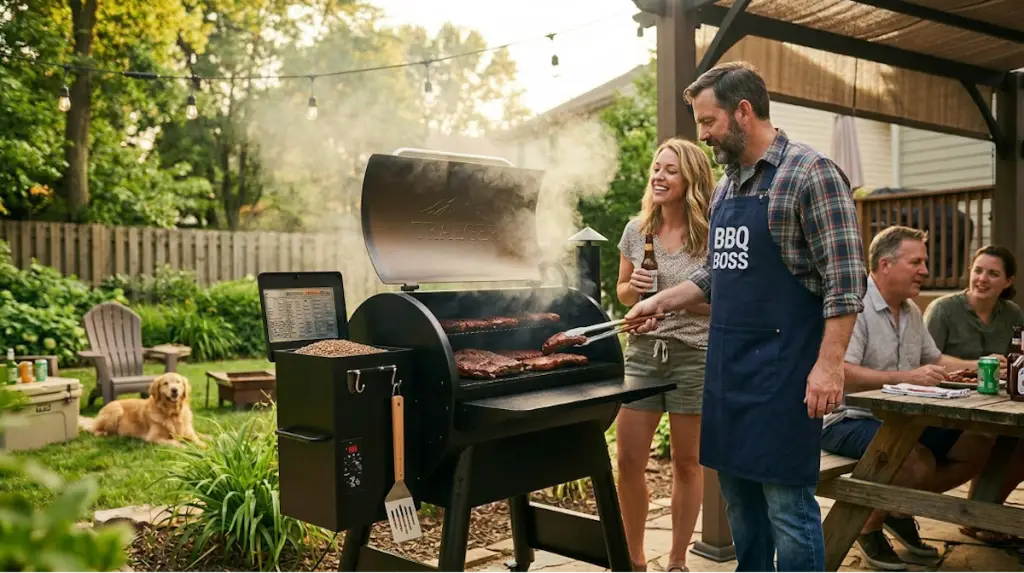
Pellet smokers have exploded in popularity over the past decade, and for good reason. They make smoking meat surprisingly approachable.
Instead of charcoal or gas, pellet smokers burn small, compressed wood pellets. These pellets feed into a fire automatically from a hopper, and the grill controls the temperature using a digital thermostat.
In other words, a pellet smoker behaves a little like an outdoor oven that happens to produce delicious wood smoke.
For beginners, that simplicity is incredibly appealing. You set the temperature, load the pellets, and the smoker handles the rest. It’s easier than convincing your brother-in-law that they should add bacon to their cheeseburger. The grill automatically feeds fuel into the fire to maintain the heat you selected.
This makes long cooks much less stressful. Brisket, pork shoulder, and ribs can cook for hours while the smoker quietly does its job. You still get the fun of outdoor cooking without constantly adjusting vents or adding fuel.
Pellet smokers also produce very consistent temperatures, which helps beginners avoid one of the biggest frustrations in smoking: chasing the thermometer around the dial.
The tradeoff is cost. Pellet smokers are usually more expensive than basic charcoal smokers, and they require electricity to run the control system and pellet auger. They also have more mechanical parts, which means there’s a little more technology involved than with a simple charcoal setup.
But for many backyard cooks, pellet smokers hit a very nice balance between convenience and flavor.
If you want a smoker that makes it easy to start producing great food quickly, pellet smokers are often the most beginner-friendly choice.
Charcoal Smokers (The Traditional BBQ Experience)
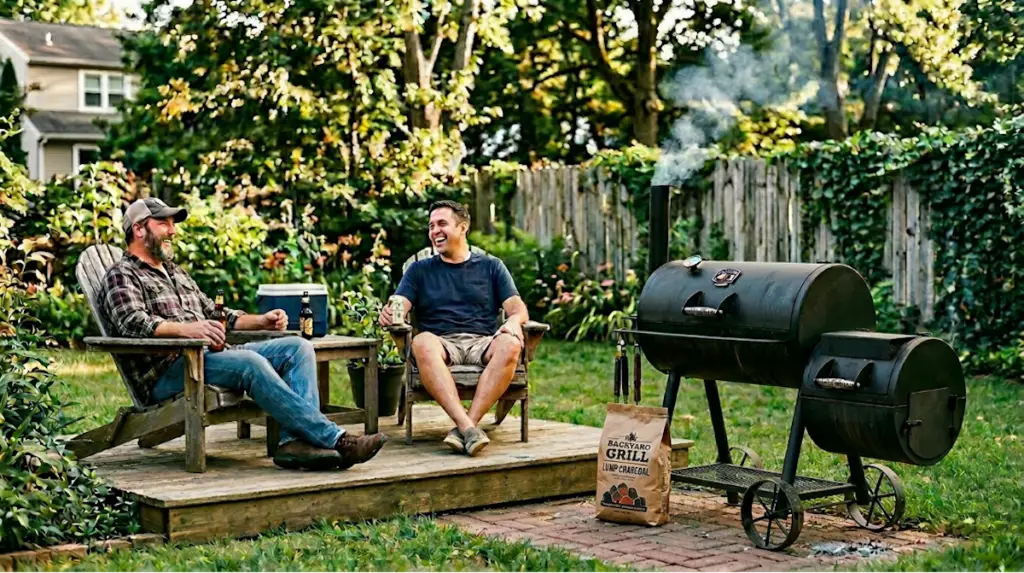
Charcoal smokers represent the traditional side of backyard barbecue. If you’ve ever seen someone carefully tending a smoker with a beverage in one hand and a thermometer in the other, there’s a good chance charcoal was involved. This is peak BBQ Dad energy.
Charcoal smokers burn charcoal as the primary heat source, with wood chunks added to produce smoke flavor. Air vents control how much oxygen reaches the fire, which in turn controls the cooking temperature.
That may sound complicated at first, but it’s really just a matter of learning how your smoker behaves.
Many beginners start with charcoal smokers because they are relatively affordable and wonderfully simple. There’s something satisfying about building a fire, adjusting the vents, and watching the smoker settle into its rhythm. It’s kind of like learning to drive a stick shift. Confusing at first, but once you get the hang of it, it’s awesome.
Charcoal smokers also produce the kind of deep smoke flavor that many people associate with classic barbecue.
The main learning curve is temperature control. Because you’re managing a live fire, you’ll occasionally adjust airflow or add charcoal during longer cooks. At first, this feels like juggling flaming bowling pins. But, after a few cooks, it starts to feel natural.
And there’s an upside to that learning curve.
Many people discover that tending a charcoal smoker becomes part of the fun. It slows the day down a little. You check the temperature, adjust a vent, talk to your guests, grab another beer, and generally enjoy the process.
If you like the idea of being more involved with the fire itself, charcoal smokers are a fantastic place to start.
Electric Smokers (The Simplest Option)
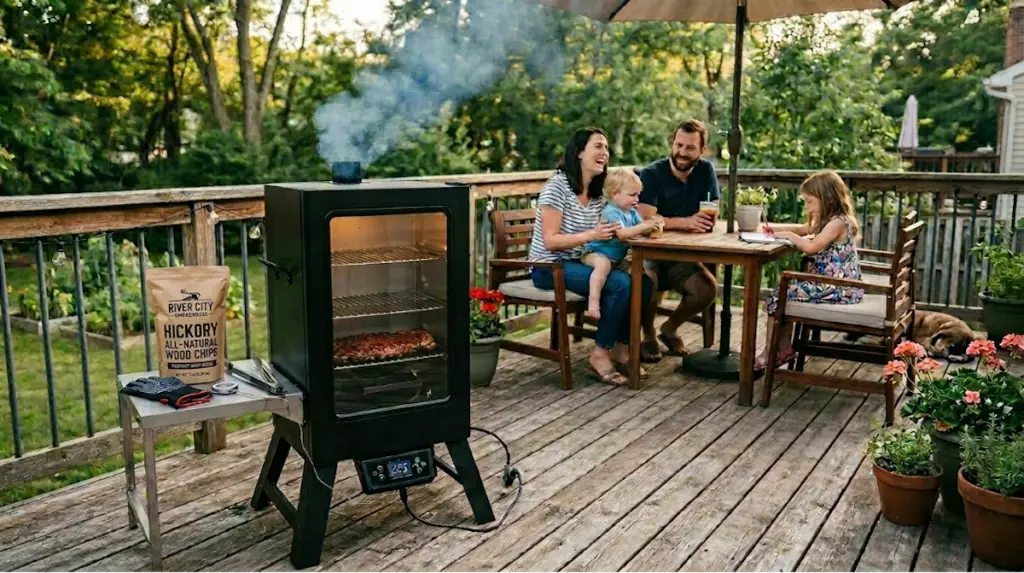
Electric smokers are probably the least intimidating entry point into the world of smoking meat.
You plug them in, set a temperature, add some wood chips for smoke, and let the smoker do its thing. Inside the cabinet, an electric heating element provides the heat while the wood chips add flavor.
For beginners who want something straightforward and predictable, electric smokers can be very appealing. There’s no charcoal to manage and no propane tanks to worry about. Temperature control is typically very stable, which means less time staring at the thermometer like it owes you money. This helps reduce the “what am I doing wrong?” phase that many beginners experience.
Electric smokers are also compact and well-suited for patios or smaller outdoor spaces.
The main compromise is smoke intensity. Because electric smokers generate heat differently than charcoal or wood fires, the smoke flavor tends to be a bit lighter. For many backyard cooks, this is perfectly fine, but hardcore barbecue enthusiasts sometimes prefer the flavor produced by charcoal or wood.
Still, plenty of excellent food comes out of electric smokers every weekend.
If your goal is to keep things simple while learning the basics of smoking meat, electric smokers are a perfectly respectable way to start.
Propane Smokers (Gas-Powered Simplicity)
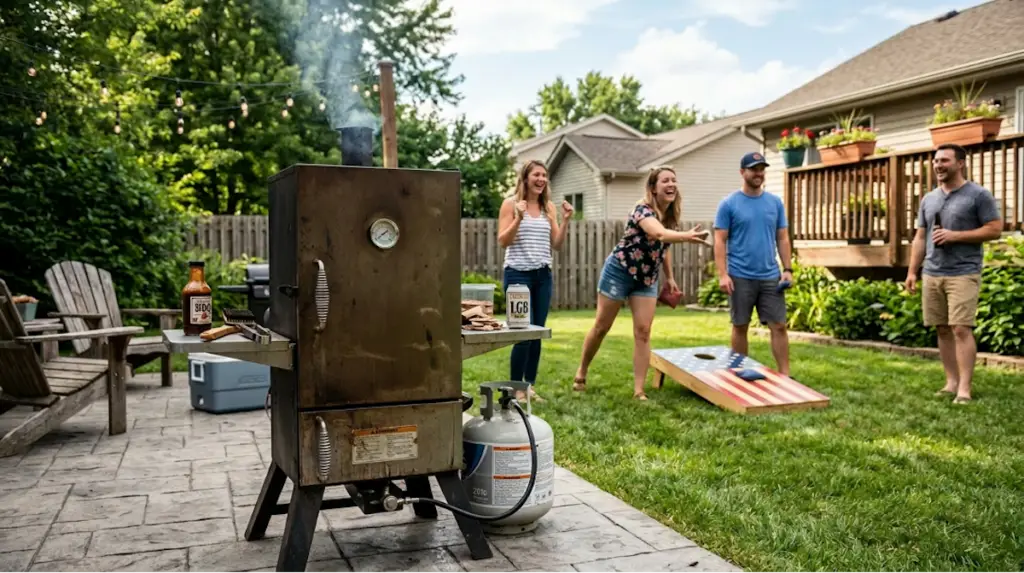
Propane smokers occupy a middle ground between charcoal and electric designs.
They use a propane burner to create heat while wood chips provide the smoke flavor. In many ways, they operate similarly to propane grills, which makes them familiar territory for people who already cook with gas.
If you’ve ever used a gas grill, a propane smoker will feel pretty intuitive. You turn on the gas, ignite the burner, and adjust the flame until the smoker settles into the temperature you want.
Compared with charcoal smokers, temperature control is usually a little easier because you’re adjusting a burner rather than managing airflow to a fire. Once the smoker gets going, it can hold steady heat for hours.
Propane smokers also heat up fairly quickly, which is nice when you decide at 10 a.m. that today feels like a good day to smoke something, and your friends are coming over at one. You still won’t get a brisket in, but wings are another story.
The main reason you don’t see them discussed as often today is that pellet smokers have taken over much of the “easy smoking” space in the backyard barbecue world. But propane smokers still work well, especially for people who already cook with gas and like that style of control.
If propane grills feel natural to you, a propane smoker can be a very comfortable way to step into the world of smoking meat.
So What’s the Best Smoker for Beginners?
This is the part where many articles try to declare a single winner.
The best smoker for beginners depends on what kind of experience you’re looking for.
If you want the easiest path to consistent results with minimal fuss, pellet smokers are hard to beat. They remove much of the learning curve for temperature management and make long cooks much less intimidating.
If you like the idea of traditional barbecue and don’t mind tending a fire now and then, charcoal smokers offer a classic experience and excellent flavor.
If simplicity is your top priority, electric smokers provide a plug-and-play way to start learning how smoking works.
And if you already cook comfortably with propane, a gas smoker can feel very familiar and easy to control.
The good news is that none of these choices lock you into a permanent identity as a “pellet person” or a “charcoal person.” Backyard cooks try different setups all the time. Your first smoker is simply the one that gets you started.
What to Look for in a Beginner Smoker
Regardless of which fuel type you choose, a few features make the learning process easier.
First, look for stable temperature control. A smoker that holds steady heat helps you focus on cooking instead of constantly adjusting the fire.
Second, make sure the cooking area is large enough for what you plan to cook. Even beginners quickly discover that ribs multiply when guests show up.
Fuel access also matters. Whether it’s adding charcoal, pellets, or wood chips, you want the process to be simple, not awkward.
Finally, durability counts. A smoker that feels solid and well-built will be easier to learn on and more enjoyable to use over time.
None of these factors require spending a fortune. Many beginner smokers offer excellent performance without demanding a low-interest HELOC.
Your First Smoker Doesn’t Have to Be Perfect
One of the biggest myths in barbecue is that great food requires the perfect equipment. It doesn’t.
People cook incredible barbecue on simple smokers, kettle grills, homemade rigs, and occasionally things that appear to have been assembled from spare parts in a garage. You can even make a smoker out of an old filing cabinet or a couple of clay pots (I’ll show you that trick later). BBQ folks are sometimes a bit too creative.
The real ingredients behind good barbecue are patience, temperature control, and a willingness to learn from each cook.
Your first smoker isn’t a lifelong commitment. It’s a starting point. And starting is the part that actually matters.
Ready to Start Smoking?
Choosing your first smoker is an exciting step, but the smoker itself is only part of the story.
What really matters is understanding how heat, smoke, and time work together.
If you’re just getting started, the next thing to learn is the basic process behind smoking meat. Once you understand that foundation, the equipment becomes much less intimidating.
Next step: Smoking Meat for Beginners
That guide walks through the fundamentals so your first cook feels manageable instead of mysterious.
One Last Thing Before You Fire It Up
Your first few cooks may not be perfect.
Ribs might finish early. Chicken might take longer than expected. At some point, you will stand next to a smoker staring at a thermometer like it personally betrayed you and your entire family.
That’s normal. Every BBQ Dad has been there.
But once you start learning how your smoker behaves, the process becomes surprisingly rewarding. The smell of wood smoke drifting through the yard, friends wandering over to see what’s cooking, the quiet satisfaction of pulling something delicious off the smoker — it all comes together pretty quickly.
So pick a smoker that feels right, fire it up, and try something simple. After that, you’ll start inventing reasons to smoke random types of meat every weekend. If it goes sideways, congratulations. You’re officially learning how to barbecue.
If this feels like your kind of BBQ…
Join the BBQ Crew below for practical BBQ tips, easy recipes, and backyard ideas that work.
No spam. Just good BBQ.